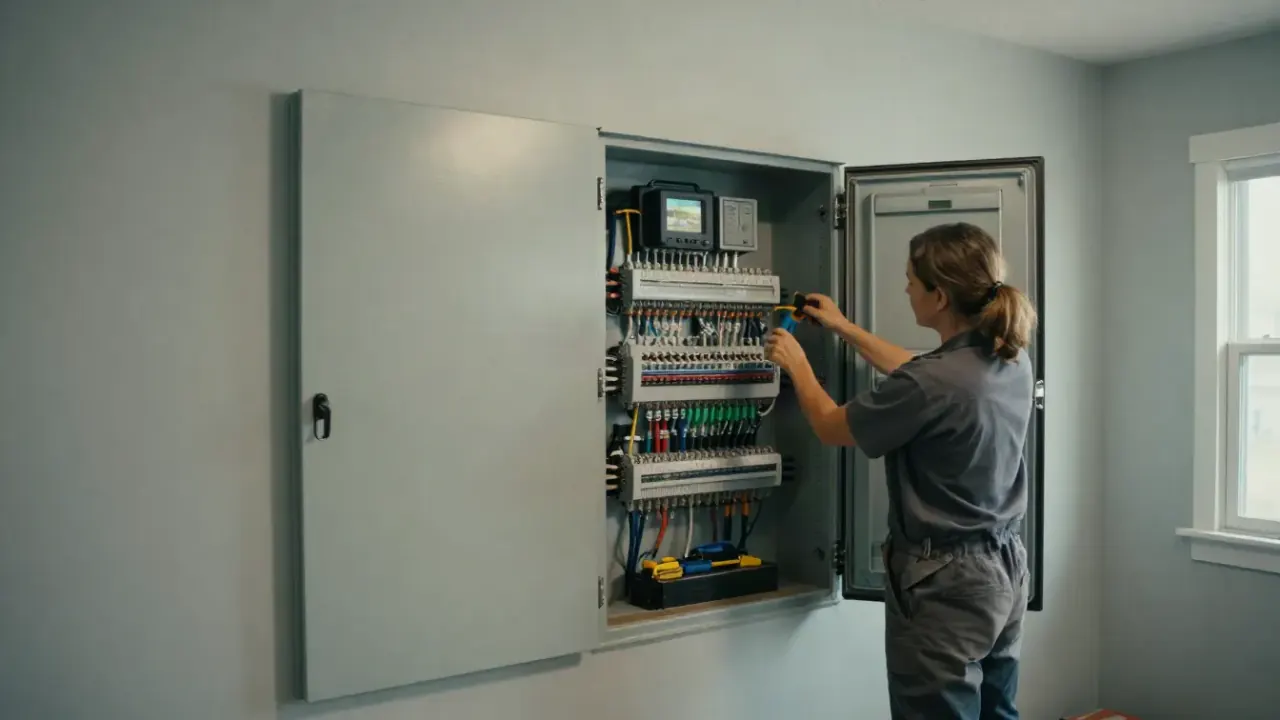
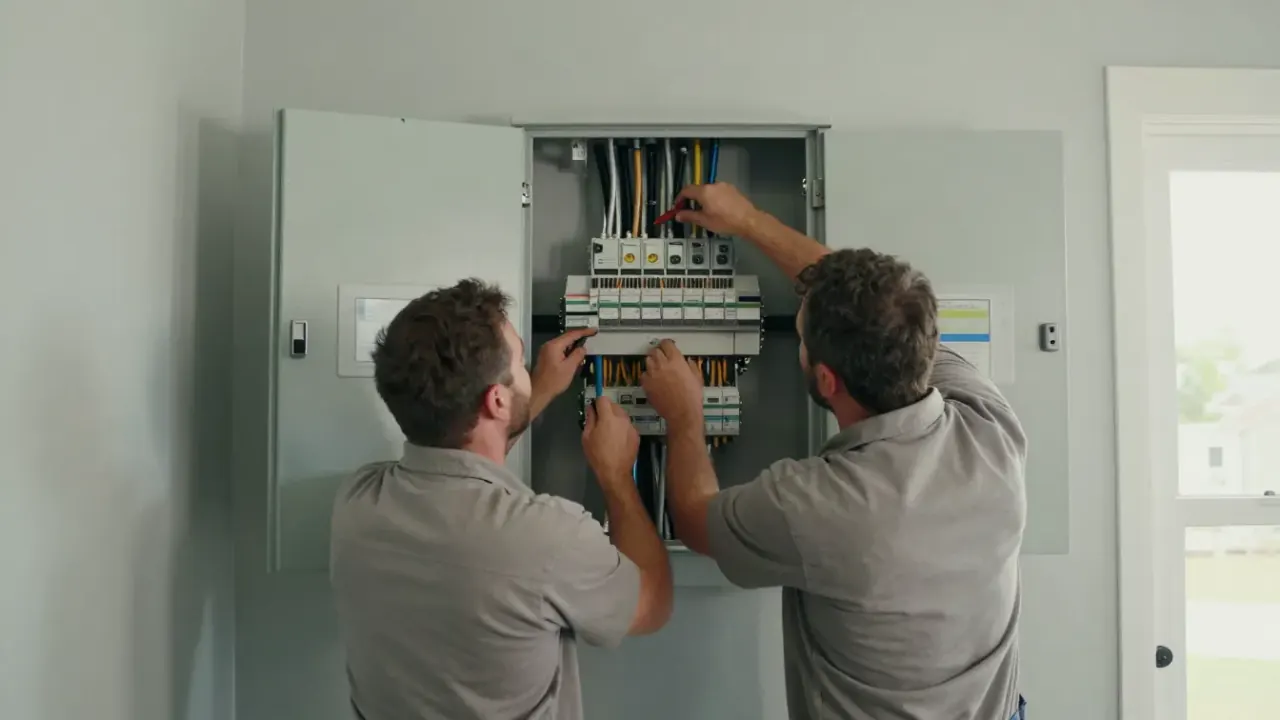
How to Prepare Your Electrical Panel for an EV Charger
A Level 2 EV charger pulls 40-48 amps continuously. Here's how Woodstock homeowners check panel capacity, size the breaker, and prep for installation.
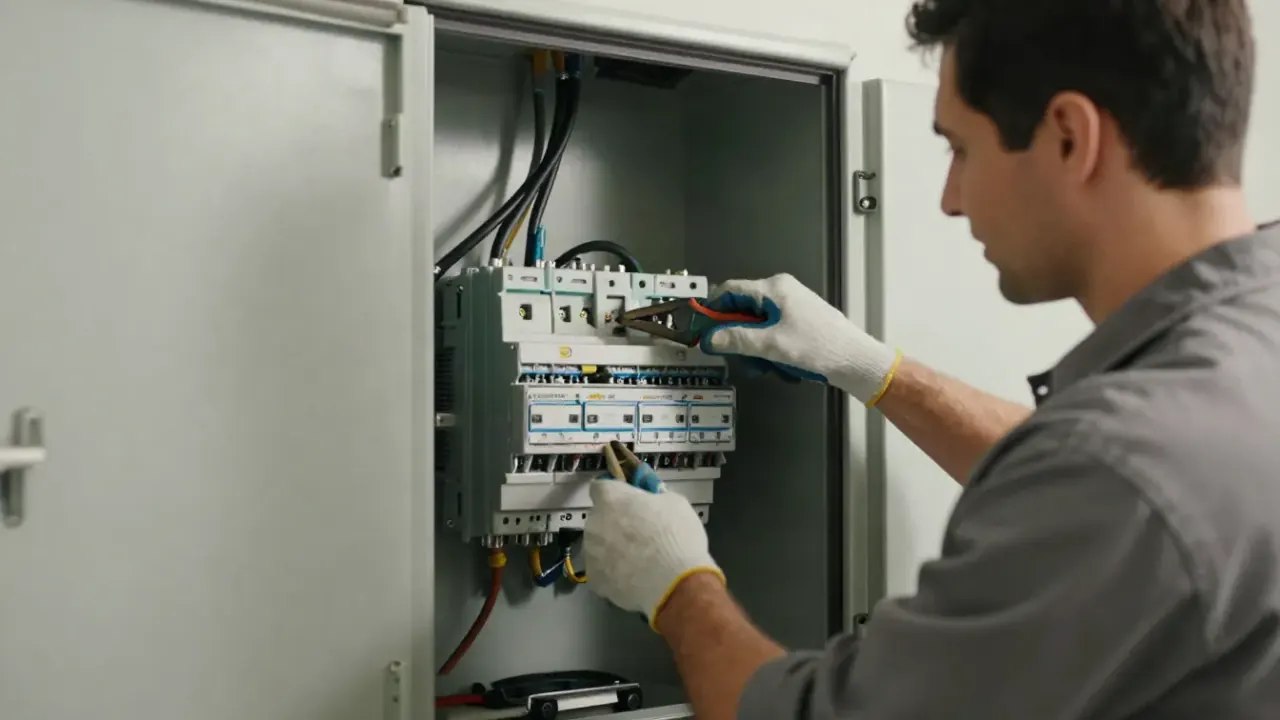
Preparing your electrical panel for an EV charger in Woodstock, GA means confirming you have enough spare amperage, installing a dedicated 240-volt circuit with the correct breaker, and upgrading the panel only if your load calculation says you must. Most homes built after 1990 with a 200-amp service can handle a Level 2 charger without a panel swap. Older homes on 100-amp service usually cannot.
We install EV chargers across Cherokee County every week, and the panel side of the job is where most of the real work lives. This guide walks through what your charger actually draws, how to read your own panel, when an upgrade is unavoidable, and what the whole thing costs in 2026.
What an EV Charger Actually Demands From Your Panel
A Level 2 EV charger in Woodstock draws 32 to 48 amps continuously for hours at a time - far more than any other single appliance in your house. That continuous draw is the whole reason panel capacity matters so much.
Here is the math most homeowners never see. A 40-amp charger on a 50-amp breaker pulls 9.6 kilowatts. Charge for six hours and you have moved roughly 58 kWh into the car. Your electric range, by comparison, might pull 40 amps but only for 30 minutes at dinner. The charger runs while you sleep, while the HVAC cycles, while the water heater recovers.
The National Electrical Code treats EV charging as a continuous load, which means the circuit must be sized at 125% of the charger's rated output. A 40-amp charger needs a 50-amp breaker and 6-gauge copper wire. A 48-amp charger needs a 60-amp breaker and 4-gauge wire. Undersize either one and you get nuisance tripping in summer, warm breakers, and a charger that derates itself.
Level 1 charging - the cord that plugs into a standard 120-volt outlet - draws only 12 amps and needs no panel work at all. It also adds about 4 miles of range per hour. For a commuter doing 40 miles a day, that is a seven-hour top-up. For anyone driving more, Level 2 is the only realistic option.
How to Check Your Current Panel Capacity
Your panel's total capacity is printed on the main breaker or the panel label - usually 100, 150, or 200 amps. That number is your ceiling. What matters for an EV charger is how much of it is already spoken for.
Open the panel door and look at three things:
- Main breaker rating. 100A, 150A, or 200A. This is your service size.
- Spare breaker slots. A 240-volt EV circuit needs two adjacent slots. If the panel is full, you need tandem breakers or a subpanel.
- Existing large loads. Electric range (40-50A), electric dryer (30A), central AC (30-50A), electric water heater (30A), heat pump (30-60A). Add these up.
A quick rule of thumb: on a 200-amp panel, if you have an electric range, electric dryer, and central AC already, you are probably sitting around 120-140 amps of calculated load. Adding a 40-amp continuous charger pushes you toward 170-180. That fits, but it is tight, and a licensed electrician should run the actual numbers.
On a 100-amp panel with those same appliances, you are already near capacity. There is no honest way to add a 40-amp charger without upgrading the service. We run into this constantly in the older ranch homes around Downtown Woodstock electrical panel upgrade work, where 1970s and 1980s construction still has the original 100-amp fuse or breaker panel.
If you want the real answer instead of a guess, our electrical panel inspection and load calculation Woodstock GA service produces a written load sheet using the NEC Article 220 method. That document is what tells you yes or no.
Do You Need a Panel Upgrade for an EV Charger in Woodstock, GA?
You need a panel upgrade for an EV charger in Woodstock if your calculated load plus the charger exceeds your service rating, or if your panel is a discontinued brand with known failure issues. Otherwise, you likely do not.
Three scenarios almost always require an upgrade:
- 100-amp service with any large electric appliances. The charger alone eats 40-50% of your capacity.
- Federal Pacific Stab-Lok or Zinsco panels. These are known to fail to trip on overload. No electrician should add a continuous 40-amp load to one.
- Full panels with no spare slots and no room for tandems. Sometimes a subpanel solves this instead of a full service upgrade.
When an upgrade is the answer, most Woodstock homes go from 100 amps to 200 amps. That is the standard residential service size in Cherokee County and gives you room for the charger plus future loads like a heat pump or a shop circuit. Our 200 amp service upgrade Woodstock work typically takes one day, with a brief power shutdown while we swap the meter main and panel.
If your panel is fine but full, a subpanel installation Woodstock GA in the garage is often the cheaper path. We feed a 60- or 100-amp subpanel off the main, then land the EV circuit there. Shorter wire run, less drywall work, and you keep the main panel untouched.
Breaker Sizing and Wiring: What the Job Requires
Breaker size for an EV charger in Woodstock is set by the charger's output, not by guesswork. Match the breaker to the unit and the wire to the breaker.
- 32-amp charger: 40-amp breaker, 8-gauge copper, NEMA 14-50 or hardwired.
- 40-amp charger: 50-amp breaker, 6-gauge copper, usually hardwired.
- 48-amp charger: 60-amp breaker, 4-gauge copper, hardwired only.
Hardwiring is now the default for new installs. The 2023 NEC requires a GFCI breaker for any 240-volt receptacle in a garage, and those breakers cost $120-$180 and are prone to nuisance tripping with EV chargers. Hardwiring sidesteps the GFCI requirement because the charger has its own internal ground-fault protection. It also lets you run the full 48 amps.
Wire run length matters. Past about 100 feet from panel to charger, voltage drop forces you up a wire size. A detached garage or a charger on the far side of a large home can turn a 6-gauge run into a 4-gauge run, which adds $200-$400 in copper alone.
Every EV circuit we install also gets an AFCI breaker installation Woodstock GA where the code cycle requires it, and we torque every lug to spec. Loose terminations on a circuit that runs hot for six hours straight are how panels fail.
EV Charger Installation Checklist for Woodstock Homeowners
Here is the sequence we follow on every EV charger installation prep in Woodstock, Georgia, from the first phone call to the first charge.
- Pull the panel label and main breaker rating. Photo of the open panel is enough to start.
- List every large electric load. Range, dryer, AC, water heater, heat pump, well pump, hot tub.
- Run the Article 220 load calculation. This is the yes-or-no moment.
- Decide charger amperage. 40A is plenty for most; 48A if you drive 100+ miles a day.
- Pick the location. Driver's-side front quarter panel, 4-6 feet of slack, out of the snow line.
- Confirm the circuit path. Attic, crawlspace, or exterior conduit - this drives labor cost.
- Pull the permit. Cherokee County requires one for new 240V circuits.
- Install, torque, test, and label. We leave the breaker labeled and the load sheet with you.
Steps 1 through 3 are the part homeowners can do themselves in about 20 minutes. Everything after that is licensed work.
What It Costs to Prepare a Panel for an EV Charger in Woodstock
Typical 2026 pricing in this area runs $650-$1,400 for a straightforward Level 2 circuit on a panel with spare capacity, and $2,200-$3,800 when a 200-amp service upgrade is required.
Here is how that breaks down:
- EV circuit only, panel has room: $650-$1,400 including permit, breaker, wire, and labor.
- Long or complex run (detached garage, 100+ ft): add $300-$800.
- Subpanel in the garage: $900-$1,600 installed.
- 100-amp to 200-amp service upgrade: $2,200-$3,800, including new meter main and panel.
- Charger itself: $400-$800 for the unit, not included in the above.
Utility rebates come and go. Georgia Power has offered EV charger rebates in past program cycles, and we check current availability before we quote so you are not leaving money on the table. We give you a flat number up front - no hourly surprises.
Common Mistakes We See on EV Charger Jobs
The same handful of errors shows up on almost every DIY or cut-rate EV charger job we get called to fix in Woodstock.
Guessing at panel capacity. Homeowners see an empty slot and assume they are fine. Empty slots mean nothing if the calculated load is already at the limit. We have pulled 40-amp chargers off 100-amp panels that were tripping the main every hot afternoon.
Using a NEMA 14-50 receptacle on a 60-amp circuit. The outlet is rated for 50 amps. Putting a 48-amp charger on it is a code violation and a fire risk. Hardwire it.
Aluminum wire on the EV circuit. Aluminum is fine for the service entrance but a bad idea for a continuous 40-amp branch circuit in a garage. Use copper.
Skipping the permit. Unpermitted 240V circuits surface at resale and can void insurance claims. Cherokee County permits for EV circuits are inexpensive and quick.
Ignoring the panel brand. Adding a continuous load to a Federal Pacific or Zinsco panel is asking for trouble. Those panels get replaced first.
If you are also thinking about backup power for storm season - and in Cherokee County, that is a real consideration - the same panel work supports a generator interlock and transfer switch installation Woodstock GA. We often bundle the two so the panel is opened once.
When to Call a Professional
Call a licensed electrician the moment your load calculation is close to the line, your panel is a discontinued brand, or your charger run crosses more than 50 feet. Those three conditions cover about 70% of the EV charger jobs we see in Woodstock.
We handle the whole job: load calculation, permit, panel work if needed, circuit run, charger mounting, and testing. If your panel is fine, we tell you so and just install the circuit. If it needs an upgrade, we show you the numbers that prove it before you spend a dollar.
Woodstock Electrical Panel Upgrade works across Cherokee County, including the neighborhoods around Towne Lake electrical panel upgrade territory where a lot of 1990s homes are now adding their second EV. Same-day quotes, flat pricing, and we clean up before we leave.
Frequently Asked Questions
Do I need to upgrade my panel for an EV charger in Woodstock, GA?
Only if your calculated load plus the charger exceeds your service rating - usually the case on 100-amp panels with electric appliances. Most 200-amp homes built after 1990 can add a 40-amp charger without an upgrade. A load calculation gives you the definitive answer.
How much does it cost to prepare a panel for an EV charger in Woodstock, Georgia?
Expect $650-$1,400 for the circuit alone if your panel has capacity, or $2,200-$3,800 if a 100-to-200-amp service upgrade is required. Long wire runs and detached garages add $300-$800. The charger unit itself is separate.
What size breaker for an EV charger in Woodstock, GA?
A 40-amp charger needs a 50-amp breaker with 6-gauge copper wire. A 48-amp charger needs a 60-amp breaker with 4-gauge wire. A 32-amp charger uses a 40-amp breaker. The breaker is always sized at 125% of the charger's continuous output.
Can my current panel handle an EV charger in Woodstock?
If you have 200-amp service with spare slots and no more than two large electric appliances, almost certainly yes. If you have 100-amp service, a full panel, or a Federal Pacific or Zinsco panel, no. We confirm with an Article 220 load calculation before quoting.
How long does the installation take?
A straightforward EV circuit on a panel with capacity takes 3-5 hours. A full 100-to-200-amp service upgrade plus the charger takes one full day, with power off for 4-6 hours during the panel swap.
Get Help With Electrical Panel Upgrade in Woodstock
Whether you need a simple EV circuit or a full service upgrade to make it work, we will give you the load numbers first and a flat price second. Call Woodstock Electrical Panel Upgrade at (470) 742-0135 and we will tell you exactly what your panel can handle.